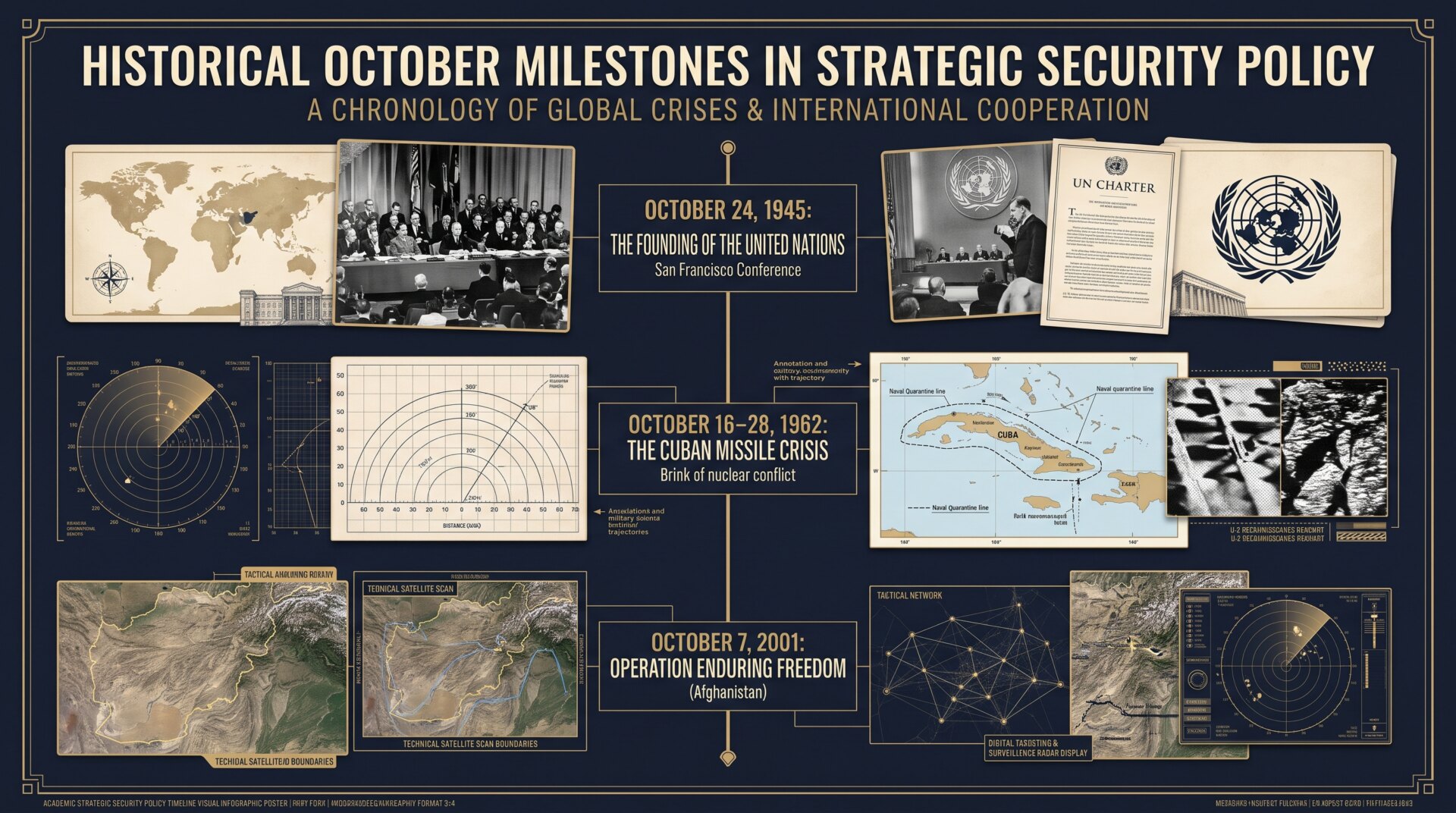
Key Takeaways (Executive Summary)
UN Charter (October 24, 1945): Codified the prohibition of force (Article 2(4)) and institutionalized collective security alongside Great Power realpolitik via the Security Council (Chapter VII).
Cuban Missile Crisis (October 16–29, 1962): Highlighted the operational risks of nuclear brinkmanship, leading to the creation of the Washington–Moscow Hotline and modern decision-making models.
Operation Enduring Freedom (October 7, 2001): Triggered NATO’s Article 5 for the first time, introducing the „Afghan Model” of light-footprint precision warfare and long-term COIN challenges.
1. Entry into Force of the United Nations Charter (October 24, 1945)
1.1 Structural Foundations and Legal Architecture
The formal entry into force of the United Nations Charter on October 24, 1945, represented a decisive structural transformation in global security governance. Following the failure of the League of Nations to prevent systemic conflict in the 1930s, the Allied powers constructed a legally binding international architecture to enforce peace and regulate state behavior. Drafted at the United Nations Conference on International Organization in San Francisco, the Charter established a centralized institutional framework centered on maintaining international peace and security.
The Charter’s core legal innovation lies in Article 2(4), which codified a comprehensive prohibition on the threat or use of force against the territorial integrity or political independence of any state. This norm replaced the classical jus ad bellum framework of Westphalian sovereignty with a restricted regime where armed force is legitimate under only two specific exceptions:
Individual or collective self-defense in response to an armed attack (Article 51).
Explicit authorization by the United Nations Security Council (UNSC) under Chapter VII.
Chapter VII provides the UNSC with sweeping coercive powers. Under Article 39, the Security Council holds the sole authority to determine threats to peace, breaches of peace, or acts of aggression. Once identified, the Council can mandate non-military sanctions (Article 41) or authorize military force (Article 42) to restore international security.
1.2 Realpolitik and Security Council Veto Dynamics
While the Charter established normative principles of sovereign equality (Article 2(1)), its structural implementation acknowledged power politics. By granting permanent membership and veto power (the P5) in the Security Council to the primary victors of World War II—the United States, Soviet Union, United Kingdom, France, and China—the Charter embedded a compromise between universal normative aspirations and Great Power realpolitik.
This design reflected the consensus that collective security could function only if Great Powers were legally shielded from enforcement actions against one another, thereby preventing direct military conflict between nuclear-capable states. However, this architectural constraint generated systemic vulnerabilities:
Strategic Paralysis: During the Cold War, opposing superpowers frequently utilized the veto to block UN intervention in conflicts within their spheres of influence.
Informal Adaptation: To bypass Security Council gridlock, the UN General Assembly adopted the Uniting for Peace resolution (Resolution 377A) in 1950, allowing recommendations for collective action when the Security Council stalled.
Emergence of Peacekeeping: Because Chapter VII enforcement actions were frequently stymied, the UN developed traditional „Chapter VI and a Half” peacekeeping operations—deploying neutral military observers with host-state consent to maintain ceasefires.
1.3 Strategic Communication and Contemporary Relevance
From a strategic communication perspective, the UN Charter created a permanent platform for diplomatic signaling and crisis management. The Security Council serves as a critical forum for narrative warfare, normative framing, and public diplomacy. States routinely utilize UN debates to build international legitimacy, justify military interventions, or expose the legal vulnerabilities of strategic rivals.
In contemporary security policy, the UN Charter framework faces severe stress tests, including grey-zone aggression, cyber operations, proxy warfare, and direct breaches of territorial sovereignty by P5 members. Despite these strains, the legal principles established on October 24, 1945, remain the baseline benchmark for evaluating the legitimacy of military operations worldwide.
References & Key Literature
Bowett, D. W. (2009). Self-defence in international law. Manchester University Press.
Chesterman, S. (2001). Just war or just peace? Humanitarian intervention and international law. Oxford University Press.
Garey, A. (2020). The United Nations and security sector reform: Policy and practice. Routledge.
Kelsen, H. (2000). The law of the United Nations: A critical analysis of its fundamental problems. The Lawbook Exchange.
Weiss, T. G., & Daws, S. (Eds.). (2018). The Oxford handbook on the United Nations (2nd ed.). Oxford University Press.
2. The Cuban Missile Crisis (October 16–29, 1962)
2.1 Escalation Dynamics and Nuclear Brinkmanship
The Cuban Missile Crisis of October 16–29, 1962, stands as the most acute nuclear confrontation in history, bringing the United States and the Soviet Union to the verge of thermonuclear exchange. The crisis began when U.S. U-2 reconnaissance aircraft confirmed the covert deployment of Soviet R-12 (SS-4) and R-14 (SS-5) medium- and intermediate-range ballistic missiles in Cuba.
From Moscow’s perspective, Operation Anadyr served dual strategic objectives: rectifying the nuclear imbalance created by U.S. missile deployments in Turkey and Italy, and deterring an American invasion of Cuba following the 1961 Bay of Pigs expedition. For Washington, nuclear missiles 90 miles off Florida fundamentally reduced strategic warning time and represented an unacceptable shift in the regional balance of power.
U.S. President John F. Kennedy established the Executive Committee of the National Security Council (ExComm) to evaluate response options. Kennedy selected a naval „quarantine”—a blockade intended to halt offensive military shipments while leaving diplomatic space for de-escalation without provoking an immediate Soviet retaliation against West Berlin.
2.2 Crisis Communication and Decision-Making Models
The thirteen days demonstrated the friction inherent in nuclear brinkmanship. Operational escalation regularly threatened to outpace diplomatic command and control:
Tactical Miscalculations: On October 27 („Black Saturday”), an American U-2 aircraft was shot down over Cuba without direct authorization from Moscow. Simultaneously, the isolated Soviet submarine B-59, subjected to non-lethal U.S. depth charges, nearly launched a nuclear-tipped torpedo due to lost communications.
Back-Channel Diplomacy: Public posturing at the UN Security Council was matched by secret negotiations. Key channels included informal contacts between KGB agent Aleksandr Feklisov and journalist John Scali, alongside direct high-level meetings between Attorney General Robert Kennedy and Soviet Ambassador Anatoly Dobrynin.
The resolution required a complex diplomatic compromise. Premier Nikita Khrushchev agreed to publicly dismantle and withdraw Soviet offensive missiles under UN verification. In return, President Kennedy pledged publicly that the U.S. would not invade Cuba, while privately agreeing to remove U.S. Jupiter missiles from Turkey.
| Strategic Dimension | American Positioning | Soviet Positioning |
| Public Stance | Naval Quarantine; Demand for immediate missile removal | Declaration of defensive aid; Resistance to U.S. piracy |
| Operational Action | DEFCON 2; Blockade; Preparation for air strikes | Covert deployment; Air defense readiness in Cuba |
| Secret Concession | Removal of Jupiter missiles from Turkey | Agreement to UN inspection/verification frameworks |
2.3 Theoretical and Strategic Aftermath
The crisis became the primary empirical foundation for modern strategic studies. Graham Allison demonstrated that state behavior during acute crises cannot be fully explained through a singular „Rational Actor” model (Model I), as decisions are heavily shaped by „Organizational Process” mechanics (Model II) and „Bureaucratic Politics” bargaining (Model III).
The realization that intelligence gaps and operational friction could trigger unintended nuclear war led directly to strategic adjustments:
Direct Communication Channels: In 1963, Washington and Moscow established the Washington–Moscow Direct Communications Link („Hotline”) to ensure rapid crisis communication.
Arms Control Regimes: The crisis catalyzed bilateral arms control, leading to the Limited Test Ban Treaty (LTBT) in 1963, the Non-Proliferation Treaty (NPT) in 1968, and the Strategic Arms Limitation Talks (SALT) in the 1970s.
References & Key Literature
Allison, G., & Zelikow, P. (1999). Essence of decision: Explaining the Cuban Missile Crisis (2nd ed.). Longman.
Blight, J. G., & Welch, D. A. (1989). On the brink: Americans and Soviets reexamine the Cuban Missile Crisis. Hill and Wang.
Dobbs, M. (2008). One minute to midnight: Kennedy, Khrushchev, and Castro on the brink of nuclear war. Alfred A. Knopf.
Gaddis, J. L. (2005). The Cold War: A new history. Penguin Press.
Trachtenberg, M. (1991). History and strategy. Princeton University Press.
3. Launch of Operation Enduring Freedom in Afghanistan (October 7, 2001)
3.1 Post-9/11 Security Paradigm and Alliance Mechanics
The initiation of Operation Enduring Freedom (OEF) on October 7, 2001, launched the Global War on Terror (GWOT) and redefined Western alliance structures. Following the September 11 terrorist attacks by al-Qaeda, the Bush administration defined the conflict as an armed attack triggering the right of national self-defense under Article 51 of the UN Charter.
On September 12, 2001, NATO allies invoked Article 5 of the Washington Treaty for the first time, declaring the attacks against the U.S. to be an attack against all member states. However, the initial military campaign did not deploy under a formal NATO command structure. Seeking maximum operational autonomy, U.S. leadership adopted an „ad hoc coalition of the willing” approach, aligned with Defense Secretary Donald Rumsfeld’s operational doctrine that „the mission determines the coalition.”