This study provides a comprehensive analysis of the evolution of security policy education over the past four decades (1984–2024). It traces the transition from the „Simplicity of Destruction”—defined by Cold War nuclear deterrence and Realist state-centric models—to the „Complexity of Resilience,” necessitated by hybrid threats, climate change, and algorithmic warfare. The article identifies four distinct eras: the Strategic Calculus of the Cold War, the Post-1991 Broadening of the security agenda, the Post-9/11 Asymmetric Turn, and the current era of Hybridity and Technological Supremacy. This report places special emphasis on the technological pulse of security, mapping the shift from nuclear physics to artificial intelligence and quantum vulnerabilities. Furthermore, the study examines pedagogical shifts from theoretical lecturing to immersive wargaming and „Red Teaming.” Finally, it provides a case study of the Hungarian educational landscape, documenting the transition from the Marxist-Leninist military doctrines of the 1980s to the „Comprehensive Approach” of the National University of Public Service (NKE).
I. 1984–1991: The Era of Strategic Calculus
In 1984, security policy education was a disciplined, almost clinical exercise in strategic mathematics. Dominated by the Neorealist paradigm—exemplified by Kenneth Waltz’s *Theory of International Politics* (1979)—the curriculum was built on the assumption that the international system is anarchic and states are rational, unitary actors. Students of the era focused on „Hard Power”: the measurable capability of a state to coerce others through military or economic might.
The pedagogical cornerstone was Nuclear Strategy. Concepts like Mutual Assured Destruction (MAD), the dynamics of the „Nuclear Triad,” and the intricacies of the SALT and START treaties formed the core of the syllabus. Security was synonymous with defense, and defense was synonymous with the state. The educational objective was to train analysts who could calculate second-strike capabilities and interpret the movement of tank divisions across the North German Plain. It was a world of high stakes but clear ontological boundaries.
II. 1991–2001: The Great Widening
The collapse of the Soviet Union acted as an ontological shock to the field. Security policy education underwent what scholars call „The Widening.” The Copenhagen School, led by Barry Buzan and Ole Wæver, introduced Securitization Theory, arguing that „security” is not an objective condition but a social construct—a „speech act.”
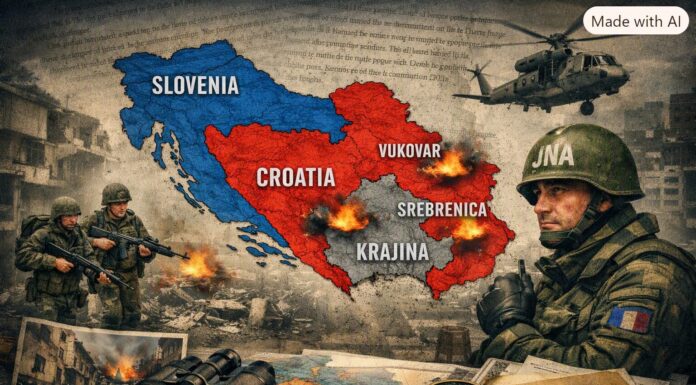
In 1994, the UNDP Human Security Report fundamentally shifted the referent object of security from the „State” to the „Individual.” Education began to include economic, food, health, and environmental security. Students were no longer just studying throw-weights of ICBMs; they were analyzing the security implications of the Balkan wars, ethnic conflict, and the collapse of „failed states.” This decade introduced the idea that security is multidisciplinary, requiring insights from sociology, economics, and environmental science.
III. 2001–2014: The Asymmetric Turn
The attacks of September 11, 2001, forced a pivot toward asymmetry. The pedagogical focus shifted from state-on-state conflict to Counter-Insurgency (COIN) and non-state actors. Mary Kaldor’s concept of „New Wars”—where the distinction between soldier and civilian, and between war and organized crime, blurs—became essential reading.
The 2006 publication of the US Army/Marine Corps Counterinsurgency Field Manual (FM 3-24) influenced civilian curricula worldwide, emphasizing „winning hearts and minds” and the „Comprehensive Approach.” This era also marked the rise of Critical Migration Studies. Scholars like Jef Huysmans (2006) highlighted how the „securitization of migration” transformed border management into a primary security concern. Education now required an understanding of cultural anthropology and the psychology of radicalization.
**IV. 2014–2024: Hybridity and Global Resilience**
Since the 2014 annexation of Crimea and the subsequent full-scale invasion of Ukraine in 2022, security education has grappled with „Hybrid Warfare.” Frank Hoffman’s theories on the blending of conventional, irregular, and cyber tactics redefined the curriculum. The focus has moved toward „Total Defense” and Societal Resilience—the ability of a nation’s infrastructure and population to withstand and recover from systemic shocks.
Climate Security (Parenti, 2011) has moved from the periphery to the centre. Students today analyse resource scarcity, water wars, and climate-induced migration not as „soft” issues, but as „threat multipliers” that can destabilise entire regions. The 2024 curriculum is characterised by „Grand Strategy” in an era of Great Power Competition (GPC), where the Arctic, the Indo-Pacific, and Outer Space are the new frontiers of confrontation.
**V. The Technological Pulse: From Nuclear Physics to Algorithmic Warfare**
Technological innovation has always been the „silent engine” of security policy. In the 1980s, security technology was largely about nuclear physics and ballistic engineering. The 1990s introduced the Revolution in Military Affairs (RMA), focusing on precision-guided munitions and the „system of systems” (Owens, 2000).
The 2000s saw the „Unmanned Revolution,” as drones (Singer, 2009) changed the ethics and practice of targeted killing. Today, the focus is on AI, Algorithmic Warfare, and Quantum Security. Security programs must now teach „Digital Forensics” and prepare for „Q-Day” (the point when quantum computers can break current encryption). The speed of the OODA loop (Observe, Orient, Decide, Act) is now determined by machine learning, forcing students to contemplate a future where „meaningful human control” over lethal force is the primary ethical and strategic challenge (Scharre, 2018).
III. 2001–2014: The Asymmetric Turn
The attacks of September 11, 2001, forced a pivot toward asymmetry. The pedagogical focus shifted from state-on-state conflict to Counter-Insurgency (COIN) and non-state actors. Mary Kaldor’s concept of „New Wars”—where the distinction between soldier and civilian, and between war and organised crime, blurs—became essential reading.
The 2006 publication of the US Army/Marine Corps Counterinsurgency Field Manual (FM 3-24) influenced civilian curricula worldwide, emphasising „winning hearts and minds” and the „Comprehensive Approach.” This era also marked the rise of Critical Migration Studies. Scholars such as Jef Huysmans (2006) have highlighted how the „securitization of migration” transformed border management into a primary security concern. Education now required an understanding of cultural anthropology and the psychology of radicalization.
IV. 2014–2024: Hybridity and Global Resilience
Since the 2014 annexation of Crimea and the subsequent full-scale invasion of Ukraine in 2022, security education has grappled with „Hybrid Warfare.” Frank Hoffman’s theories on the blending of conventional, irregular, and cyber tactics redefined the curriculum. The focus has moved toward „Total Defense” and Societal Resilience—the ability of a nation’s infrastructure and population to withstand and recover from systemic shocks.
Climate Security (Parenti, 2011) has moved from the periphery to the center. Students today analyze resource scarcity, water wars, and climate-induced migration not as „soft” issues, but as „threat multipliers” that can destabilize entire regions. The curriculum of 2024 is characterized by „Grand Strategy” in an era of Great Power Competition (GPC), where the Arctic, the Indo-Pacific, and Outer Space are the new frontiers of confrontation.
V. The Technological Pulse: From Nuclear Physics to Algorithmic Warfare
Technological innovation has always been the „silent engine” of security policy. In the 1980s, security technology was largely about nuclear physics and ballistic engineering. The 1990s introduced the Revolution in Military Affairs (RMA), focusing on precision-guided munitions and the „system of systems” (Owens, 2000).
The 2000s saw the „Unmanned Revolution,” as drones (Singer, 2009) changed the ethics and practice of targeted killing. Today, the focus is on AI, Algorithmic Warfare, and Quantum Security. Security programs must now teach „Digital Forensics” and prepare for „Q-Day” (the point when quantum computers can break current encryption). The speed of the OODA loop (Observe, Orient, Decide, Act) is now determined by machine learning, forcing students to contemplate a future where „meaningful human control” over lethal force is the primary ethical and strategic challenge (Scharre, 2018).
VI. From Lecturing to Wargaming: Pedagogical Evolution
The way we teach security has changed as much as the content. Traditional lectures are increasingly supplemented by active, immersive methods. Wargaming (Perla, 1990) has seen a massive resurgence, allowing students to simulate complex crisis management scenarios in a low-risk environment.
„Red Teaming”—the practice of viewing a problem from an adversary’s perspective (Heuer, 1999)—is now a standard skill taught in intelligence and policy tracks. Furthermore, the rise of Open-Source Intelligence (OSINT) has democratized research. In 1984, satellite imagery was the exclusive domain of superpowers; today, students are trained to geolocate conflict zones and verify human rights abuses using commercial satellite data and social media, turning the classroom into a real-time intelligence hub.
VII. The Hungarian Experience: From Zrínyi to NKE
In Hungary, the evolution of security education followed a unique historical trajectory. In 1984, the Zrínyi Miklós Military Academy was the center of education, operating within the strict ideological framework of Marxist-Leninist military doctrine and Warsaw Pact requirements. The focus was on conventional land warfare and „Socialist Patriotism.”
The 1990s brought a period of rapid „NATO-ization.” Curriculum reform focused on civilian oversight of the military, democratic accountability, and interoperability with Western allies. The 2012 establishment of the National University of Public Service (NKE) marked a turning point, integrating military, law enforcement, and diplomatic education. This „Comprehensive Approach” reflects the Hungarian reality: security is no longer just a military matter but involves disaster management, cyber defense, and public administration. Today, Hungarian students study within a framework that balances European integration with the specific challenges of the Carpathian Basin.
Conclusion
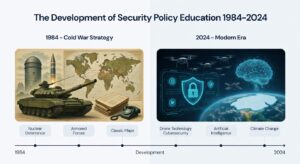
The evolution from 1984 to 2024 represents a fundamental shift from the „Simplicity of Destruction” to the „Complexity of Resilience.” Security policy education is no longer just about counting tanks or calculating megatons; it is about understanding the fragile, interconnected nodes of a globalized world. As we look toward the next forty years, the challenge for educators will be to foster „Security Literacy”—the ability to navigate a world where a computer virus can be as deadly as a kinetic missile, and where the most important battlefield is often the cognitive resilience of the population.
References
* Buzan, B., Wæver, O., & De Wilde, J. (1998). *Security: A New Framework for Analysis*. Lynne Rienner Publishers.
* Hoffman, F. G. (2007). *Conflict in the 21st Century: The Rise of Hybrid Wars*. Potomac Institute for Policy Studies.
* Heuer, R. J. (1999). *Psychology of Intelligence Analysis*. Center for the Study of Intelligence.
* Huntington, S. P. (1957). *The Soldier and the State: The Theory and Politics of Civil-Military Relations*. Harvard University Press.
* Huysmans, J. (2006). *The Politics of Insecurity: Fear, Migration and Asylum in the EU*. Routledge.
* Kaldor, M. (1999). *New and Old Wars: Organized Violence in a Global Era*. Stanford University Press.
* Lowenthal, M. M. (2022). *Intelligence: From Secrets to Policy* (9th ed.). CQ Press.
* Nye, J. S. (2004). *Soft Power: The Means to Success in World Politics*. PublicAffairs.
* Owens, W. A. (2000). *Lifting the Fog of War*. Johns Hopkins University Press.
* Parenti, C. (2011). *Tropic of Chaos: Climate Change and the New Geography of Violence*. Nation Books.
* Perla, P. P. (1990). *The Art of Wargaming*. Naval Institute Press.
* Rid, T. (2013). *Cyber War Will Not Take Place*. Oxford University Press.
* Scharre, P. (2018). *Army of None: Autonomous Weapons and the Future of War*. W. W. Norton & Company.
* Singer, P. W. (2009). *Wired for War: The Robotics Revolution and Conflict in the Twenty-first Century*. Penguin Press.
* UNDP. (1994). *Human Development Report 1994: New Dimensions of Human Security*. Oxford University Press.
* U.S. Army. (2006). *FM 3-24 Counterinsurgency*. Headquarters, Department of the Army.
* Waltz, K. N. (1979). *Theory of International Politics*. Addison-Wesley.
* Zenko, M. (2015). *Red Team: How to Succeed by Thinking Like the Enemy*. Basic Books.