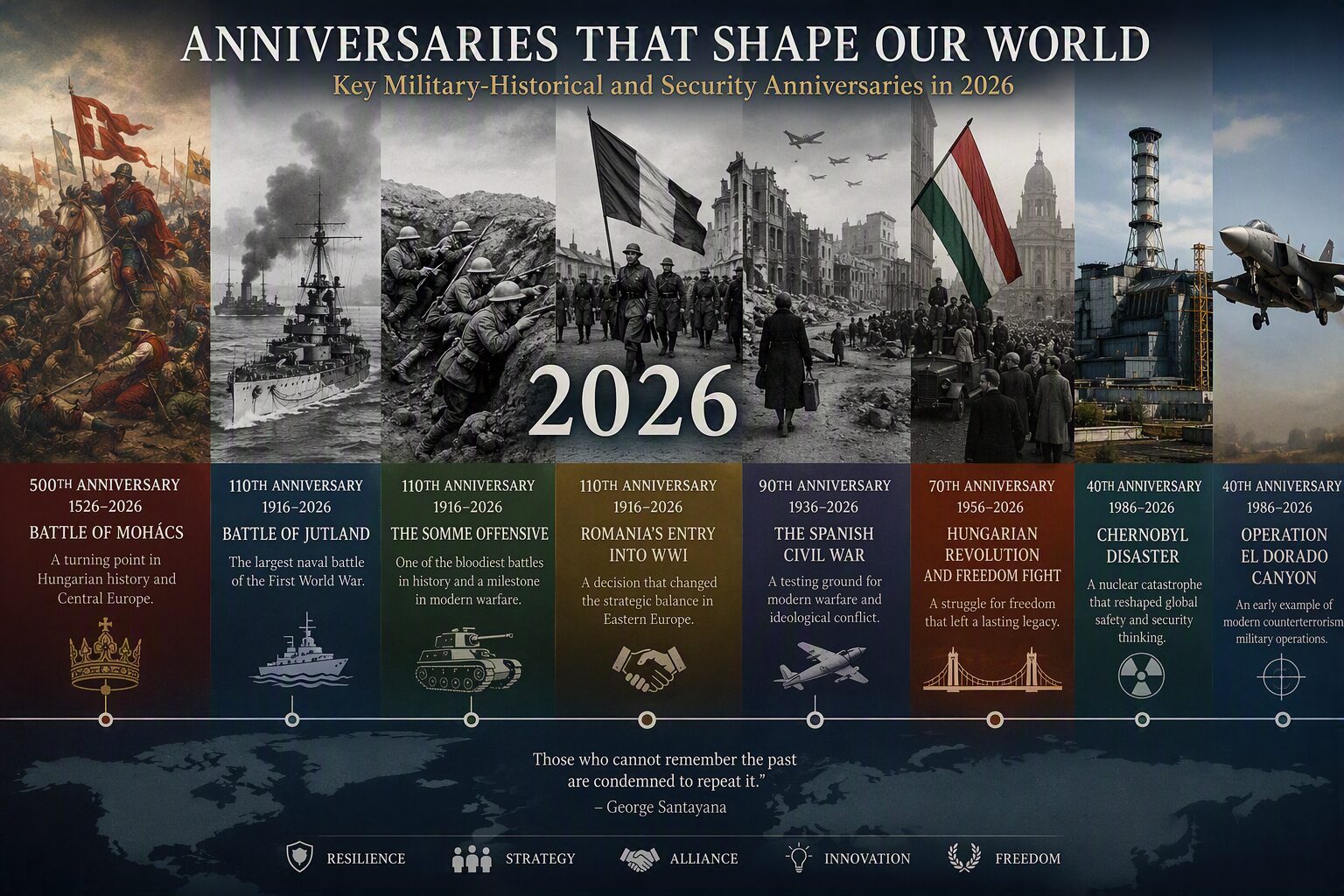
From the Battle of Mohács to the Hungarian Revolution and Chernobyl, the year 2026 marks several major military-historical and security-policy anniversaries. These events are not merely subjects of remembrance. Their strategic lessons continue to influence contemporary debates on national resilience, military modernization, alliance politics, and international security.
Why Historical Anniversaries Matter
Historical anniversaries offer more than an opportunity to celebrate victories or commemorate tragedies. They provide a framework for understanding how past conflicts, strategic decisions, and political crises continue to influence the contemporary security environment.
In 2026, several major anniversaries draw attention to critical moments in military and political history. The 500th anniversary of the Battle of Mohács, the 110th anniversaries of key First World War battles, the 70th anniversary of the Hungarian Revolution of 1956, and the 40th anniversary of the Chernobyl disaster all demonstrate how historical events can shape geopolitical developments for decades, and sometimes centuries.
For scholars, policymakers, and security professionals alike, these anniversaries provide valuable opportunities to reassess lessons that remain relevant in an increasingly uncertain international environment.
The 500th Anniversary of the Battle of Mohács (1526-2026)
The Battle of Mohács, fought on 29 August 1526, remains one of the most significant turning points in Hungarian history. During the battle, the forces of King Louis II suffered a decisive defeat against the Ottoman army led by Sultan Suleiman the Magnificent. The consequences extended far beyond the battlefield, ultimately contributing to the fragmentation of the Kingdom of Hungary and reshaping the political order of Central Europe for centuries.
The strategic significance of Mohács lies in its demonstration of how military preparedness, political cohesion, and economic capacity interact during major security crises. Modern historians increasingly emphasize that the defeat was not simply the result of a single military engagement but rather the culmination of long-term structural weaknesses, geopolitical pressures, and resource limitations.
Today, Mohács serves as a powerful reminder that national resilience depends not only on military strength but also on effective governance, sustainable economic resources, and realistic strategic planning.
Further information:
Mohács 500: https://mohacs500.hu
Mohács 1526-2026 Research Group: https://www.mohacs.btk.mta.hu
The 110th Anniversary of the Battle of Jutland (1916-2026)
The Battle of Jutland was the largest naval battle of the First World War and remains one of the most studied maritime engagements in modern military history.
Fought between the British Royal Navy and the German High Seas Fleet in May 1916, the battle produced mixed tactical results. However, from a strategic perspective, Britain maintained its naval dominance and its ability to enforce a blockade against Germany.
Jutland highlighted several themes that remain central to contemporary maritime security:
The importance of sea control.
The growing role of intelligence and communications.
The relationship between industrial capacity and military power.
The significance of strategic outcomes over tactical victories.
As maritime competition intensifies in regions such as the Indo-Pacific, the lessons of Jutland continue to influence naval planning and force development.
The 110th Anniversary of the Somme Offensive (1916-2026)
The Somme Offensive stands as one of the most devastating campaigns of the First World War. The battle produced enormous casualties, becoming a symbol of industrialized warfare and the human cost of strategic attrition.
The campaign also marked a technological milestone through the first significant combat deployment of tanks. Although their initial battlefield impact was limited, tanks would transform land warfare during the twentieth century.
The Somme illustrates several enduring realities of military conflict:
Technological innovation alone does not guarantee victory.
Strategic objectives must align with available resources.
Human factors remain critical despite technological advancement.
Military adaptation often emerges through costly battlefield experience.
In today’s era of autonomous systems, artificial intelligence, and advanced military technologies, the historical lessons of the Somme remain surprisingly relevant.
Romania’s Entry into the First World War
In August 1916, Romania entered the First World War on the side of the Entente powers. While often overshadowed by larger campaigns, this decision significantly altered the strategic balance in Eastern Europe.
The event demonstrates how medium-sized states can influence regional security environments through alliance choices and geopolitical positioning. Such lessons remain particularly relevant today, as many states seek to navigate increasing competition among larger powers.
Romania’s decision reminds us that international security is shaped not only by great powers but also by the strategic calculations of regional actors.
The 90th Anniversary of the Spanish Civil War (1936-2026)
The Spanish Civil War is frequently described as a rehearsal for the Second World War.
Beginning in 1936, the conflict became a testing ground for military technologies, operational concepts, and ideological confrontation. Foreign powers provided support to opposing sides, turning Spain into a laboratory of modern warfare.
Several developments observed during the conflict would later characterize global warfare:
Strategic aerial bombardment.
Large-scale propaganda campaigns.
Foreign military intervention.
Ideological polarization.
Information warfare.
The conflict demonstrates how civil wars can evolve into broader geopolitical confrontations, a phenomenon still visible in several contemporary security crises.
The 70th Anniversary of the Hungarian Revolution of 1956
The Hungarian Revolution of 1956 remains one of the defining political and security events of the Cold War. Beginning on 23 October 1956, the uprising challenged Soviet dominance and briefly raised hopes for greater Hungarian independence before Soviet military intervention restored control.
From a security-policy perspective, the revolution exposed the realities of Cold War geopolitics. Western governments expressed support for the Hungarian people; however, no direct military intervention occurred. The Soviet Union ultimately maintained its control over Hungary through overwhelming force.
The strategic lessons of 1956 remain relevant in contemporary discussions about:
National sovereignty.
External security guarantees.
Great-power competition.
Resistance movements.
Political legitimacy.
The revolution also became an enduring symbol of the struggle for freedom and self-determination throughout Central and Eastern Europe.
Further information:
National Committee of Remembrance: https://neb.hu
1956 Institute Archive: https://www.rev.hu
The 40th Anniversary of the Chernobyl Disaster (1986-2026)
Although not a military event, the Chernobyl nuclear disaster represents one of the most significant security-related anniversaries of 2026.
The explosion at Reactor No. 4 on 26 April 1986 demonstrated that technological failures can create security consequences extending far beyond national borders. The disaster affected public health, environmental protection, economic stability, and political legitimacy for decades.
Chernobyl significantly influenced the development of:
Nuclear safety standards.
Emergency response planning.
Critical infrastructure protection.
International crisis communication.
Environmental security policies.
Today, when discussions about energy security and nuclear power are once again prominent, Chernobyl remains an important reminder that security extends well beyond traditional military concerns.
Further information:
International Atomic Energy Agency (IAEA): https://www.iaea.org
World Nuclear Association: https://world-nuclear.org
The 40th Anniversary of Operation El Dorado Canyon
In April 1986, the United States launched Operation El Dorado Canyon, conducting air strikes against Libya in response to state-sponsored terrorist activities.
The operation became an important case study in the use of military force against non-traditional security threats. It anticipated many of the debates that would later emerge regarding counterterrorism operations, deterrence, and the use of force beyond conventional interstate conflict.
The anniversary highlights how concepts of security have evolved to address increasingly complex threats, including terrorism, organized violence, and hybrid forms of conflict.
Lessons for the Twenty-First Century
While separated by centuries and vastly different geopolitical contexts, the anniversaries of 2026 reveal several common themes:
Strategic Adaptation Matters
States that fail to adapt to changing security environments often face severe consequences.
National Resilience Is Essential
Military power alone is insufficient. Political cohesion, economic strength, social stability, and institutional effectiveness remain fundamental components of security.
Technology Changes Warfare, Not Its Nature
From Ottoman artillery to First World War tanks and modern nuclear technology, innovation consistently transforms military operations. However, strategic decision-making and human judgment remain decisive factors.
Alliances Continue to Shape Outcomes
The experiences of Mohács, Romania in 1916, and Hungary in 1956 all demonstrate the importance and limitations of alliance systems.
Conclusion
The military-historical and security-policy anniversaries of 2026 offer far more than opportunities for remembrance. They provide valuable insights into the enduring dynamics of power, conflict, resilience, and adaptation.
Whether examining the strategic consequences of Mohács, the industrialized warfare of the Somme, the geopolitical realities revealed by the Hungarian Revolution, or the broader security implications of Chernobyl, one conclusion becomes clear: understanding history remains essential for understanding security.
As global competition intensifies and new challenges emerge, the lessons of these anniversaries remind us that while technologies and actors may change, the fundamental questions of strategy, power, and survival remain remarkably consistent.